
Sometimes a script doesn’t need a full overhaul – it needs a focused conversation about one thing that isn’t quite landing. The Story Elements Workshop lets us deep‑dive into a single storytelling pillar drawn from my 7‑element framework.
What do we look at with the story elements workshop?
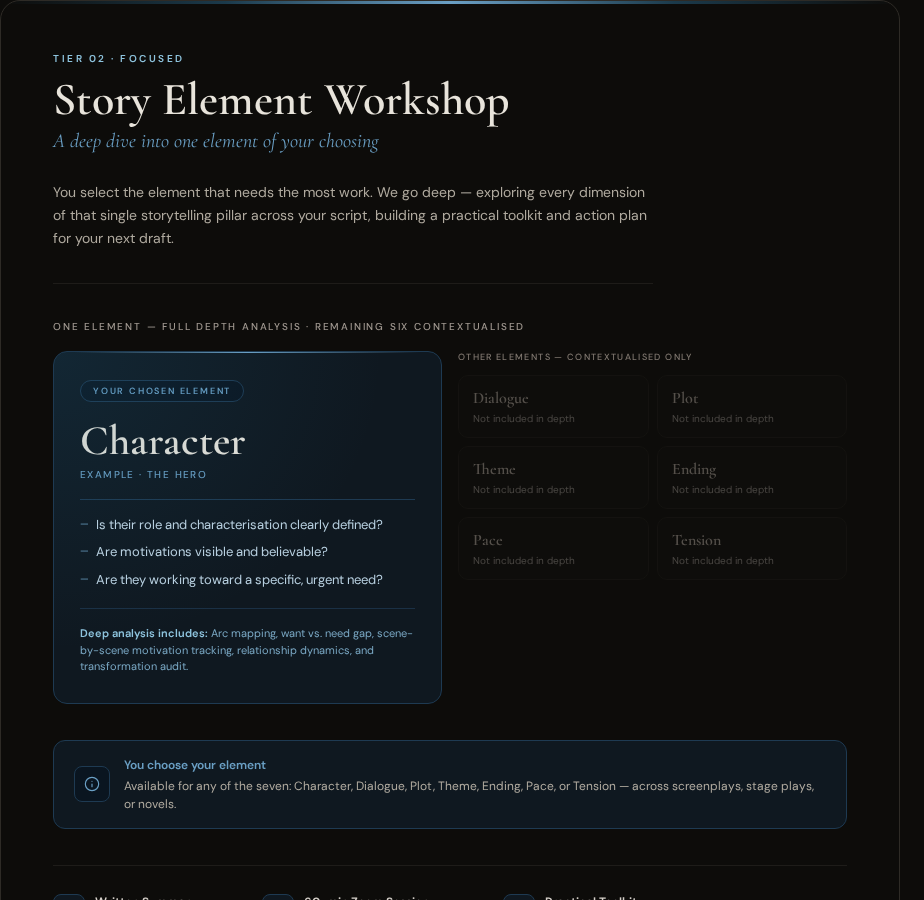
You will submit up to 30 pages in industry standard formatting.
You choose one element you’d like to focus on.
What you can expect:
1–2 pages of structured notes for the story element you have selected: character, dialogue, plot, theme, ending, pace, tension.
30 min zoom call to discuss together. Please note, additional zoom time can be purchased at £40 / 30 min.
Email follow‑up for any additional questions.
You will submit up to 60 pages in industry standard formatting.
You choose two elements you’d like to focus on.
What you can expect:
3–4 pages of structured notes for each of the seven story elements: character, dialogue, plot, theme, ending, pace, tension.
30 min zoom call to discuss together. Please note, additional zoom time can be purchased at £40 / 30 min.
Email follow-up for any additional questions.
You will submit up to 140 pages in industry standard formatting.
You choose two elements you’d like to focus on.
What you can expect:
4–5 pages of structured notes for each of the seven story elements: character, dialogue, plot, theme, ending, pace, tension.
45‑min Zoom to discuss together. Please note, additional time can be purchased for £40 / 30 min
Email follow-up for any additional questions.
Frequently Asked Questions
-
We offer a range of solutions designed to meet your needs—whether you're just getting started or scaling something bigger. Everything is tailored to help you move forward with clarity and confidence.
-
Scripts are traditionally written in 12-point Courier font. This is non-negotiable because Courier is a monospaced font, which ensures the "one page per minute" timing remains accurate.
Margins: * Left: 1.5 inches (to allow for hole-punching/binding)
Right: 1.0 inch
Top/Bottom: 1.0 inch
Alignment: Left-aligned (ragged right).
-
Script consulting is usually a broader, more developmental process. It focuses on the shape of the work — story structure, character, pacing, dramatic tension, theme, clarity, and how to make the script feel more fully alive. Script editing can sometimes be more line-by-line or draft-specific, depending on the project and the person offering it. My approach is collaborative and development-led: I’m interested in helping you strengthen the script while protecting what is distinct about your voice.
-
That depends on what kind of support you want. If you want big-picture development notes, a first draft or substantial partial draft can be completely appropriate. If you’re looking for more refined feedback, a second draft or near-complete script may be more useful. The most important thing is not perfection, but having enough material for meaningful analysis. If you’re unsure, I can help you work out which stage is the right fit.
-
PDF is usually best, as it preserves your formatting and is easy to read on any device. If your project is at an earlier stage, a Word document can also work, but PDF is generally the preferred format for scripts. If you’re unsure which file to send, I recommend whatever best reflects the draft in its current form.
-
No. You always retain full ownership of your work. My role is to support your development process, not to take any rights in your material. Your script, your story, and your voice remain yours.
-
Yes, absolutely. I treat all material in confidence and handle it with care and professionalism. I understand how personal creative work can be, and I respect the trust involved in sharing a script at any stage. Your material will not be shared, distributed, or discussed outside the consultation process.
-
Yes, if an NDA is needed, I’m happy to discuss that. I understand that many writers want reassurance that their work will be handled professionally and discreetly, especially when they are sharing early ideas or original material. If you’d like an NDA in place before sending anything, just mention it when you get in touch.
-
Working with me is collaborative, thoughtful, and writer-focused. I aim to create a space where you can be honest about what the project needs without feeling judged by the state of the draft. My job is to help you see the script more clearly, identify what is already working, and find the next steps that will move it forward while keeping your voice intact. I’m direct where it helps, but always encouraging and respectful of the writer’s process. You and your idea are the most important things in this. I am here to support and encourage your amazing process - not tear it down!
-
My practice is shaped by a deep respect for the writer’s own instincts, voice, and creative process. I’m not interested in imposing a formula or flattening something distinctive into a generic shape. Instead, I work from the material in front of me and help you uncover what the script is trying to become. Because I come from both a writing and film-production background, I’m able to combine creative sensitivity with a practical understanding of what makes a script work on stage or screen.